

Touching the Promised Land 07 | Day 2 - INTRO
Updated: Aug 16
BY THE SEA OF GALILEE
I spent my first night in Tiberias, in a hotel on the shore of the Sea of Galilee—known locally as the Kinneret and in the New Testament as the Lake of Gennesaret. My 2nd Day in Holy Land began with a sunrise view from the hotel, followed by a guided tour of key sites along the west lakeshore: Ginosar, Tabgha, and Capernaum. I then crossed into Jordan at the Jordan River border, received by my Jordan guide after crossing, visited Umm Qais and Jerash before arriving at our hotel in Amman.

My trip this time was organized by an Israeli tourist agency in partnership with local guides in Palestine (Areas A & B) and Jordan. For logistical efficiency, this ten-day journey began in Israel, moved to Jordan, and then returned to the areas on the west side of the Jordan River. For narrative flow, I will first complete the Israeli portions of the journey before writing a separate series on Jordan, covering sites like Mount Nebo, Bethany Beyond the Jordan, Umm Qais, Jerash, Madaba, Petra, and Wadi Rum.
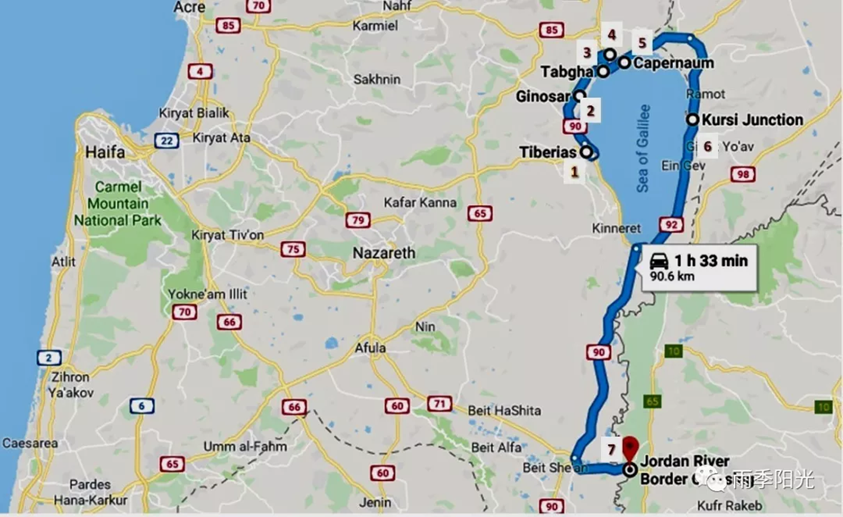
My 2nd Day's route on the west side of the lake is mapped below, featuring six stops. The first five, clustered on the northwestern shore, are all intimately connected to the ministry of Jesus.
Key Adjustments:
1. I chose to forgo the planned boat trip on the Sea of Galilee. While a serene sail was tempting, I prioritized a leisurely sunrise meditation, a relaxed breakfast, and enough time at the sacred sites. The uncertain border crossing time and the extensive ruins of Jerash further influenced this decision.
An equally compelling reason for me to forgo this boat trip was the "customary" bird-feeding activity during the morning sail, as told by the guide. The prospect of a fluttering, squawking flock is not I would usually enjoy. Therefore, it is a rather easy decision for me, which allow freeing up about an hour for other interests.
2. Hoping to glimpse the landscape of the "Gadarene swine" miracle (Mark 5:1-20), I asked if we could pass by Kursi. The site, on the lake's eastern shore, maybe have presented a logistical puzzle (which I still do not know for sure till this day). A hushed but animated discussion between my Jewish guide and Arab driver suggested a complexity beyond mere time constraints. Ultimately, they agreed to a compromise: a drive-by without entering the national park. This brief detour along the eastern shore added only 15 minutes to our journey but profoundly connected the ancient biblical story to the subtle, palpable tensions of the modern land.
Relevance to Bible and History
1. Galilee: This fertile region in northern Israel, rich with water and history, was the heartland of Jesus' ministry. Nazareth, His hometown, is in Lower Galilee. From here, He journeyed east to the Jordan River for His baptism (Matthew 3:13-17), led by the Spirit into the wilderness to face temptation (Matthew 4:1-11), and returning to call His disciples and begin His public work. After His resurrection, He specifically instructed His disciples to meet Him in Galilee (Matthew 28:10), where He appeared to them and shared a breakfast of fish by the shore (John 21:12-14). Capernaum, on the lake's shore, rightly earned its title as "His Own Ci2. The Sea of Galilee & The Rift Valley: This freshwater sea lies within the Jordan Rift Valley, part of the vast East African Rift system. This unique geology creates a land of extremes: the Dead Sea is the world's lowest lake, the Jordan River the lowest river, and the Sea of Galilee the lowest freshwater lake. Towering plateaus of volcanic basalt flank the valley, shaping both the land and biblical history:
These highlands block Mediterranean rains, creating a fertile "land of milk and honey" to the west and drier plains to the east.
The formidable terrain made crossing the Jordan River a significant barrier. The Israelites, due to their rebellion, wandered for 40 years until a new generation, under Joshua's faithful leadership, finally crossed into the Promised Land.
The dramatic elevation changes around the lake can generate sudden, violent squalls. The New Testament account of Jesus calming the storm (Matthew 8:24-26) is a powerful demonstration of His authority over the very real and unpredictable forces of nature in this location.
Sites by The Sea of Galilee:
We traveled on the day after Sukkot, the hotel was wonderfully tranquil, and the sunrise over the lake was profoundly peaceful.
After preparing for the day, we set out from Tiberias, moving clockwise around the lake:
Ginosar: At the Yigal Allon Centre, we viewed a preserved 1st-century fishing boat—the very type used by Simon Peter and Andrew when Jesus called them to become "fishers of men" (Matthew 4:18).
Tabgha: We visited the Church of the Multiplication, commemorating the feeding of the five thousand (Matthew 14:17-21), and the Church of the Primacy of St. Peter, marking the spot where Jesus reinstated Peter with the charge, "Feed my sheep" (John 21:15-17).
The Beatitudes: A short distance west, we stopped at the serene Church of the Beatitudes, overlooking the sea from the hillside where Jesus likely delivered the Sermon on the Mount (Matthew 5:3-10).
Capernaum: We explored the national park, walking among the ruins of the ancient synagogue where Jesus taught and the foundations of a house believed to be Peter's, now sheltered under a modern Catholic church.
Kursi: We passed by the area, catching a glimpse of the landscape associated with Jesus' encounter with the demon-possessed man.
Having broken the ice on the first day, my guide had adapted to my inquisitive pace. At each site, he would find a quiet spot in a garden or courtyard, share the relevant Scripture from his phone, point out key features, and then give me space for personal exploration and prayer. It was a perfectly balanced approach, allowing for both learning and quiet contemplation.
If Time Permitted…
With more time, I would have explored the ancient ruins of Tiberias, rented a simple boat at dusk for a quiet, bird-free glide on the water, or walked the shores of Kursi to see the cliffs and imagine the dramatic scene of the swine rushing into the sea (Mark 5:7-13). The region is also a haven for outdoor enthusiasts, with well-maintained trails like the Jesus Trail and Gospel Trail inviting pilgrims to walk in the footsteps of the Master—for those with ample time and the right spirit.
Touching the Promised Land | DAY 2 – SUNRISE
The Light Born Anew Over Galilee
From my balcony, the Kinneret lay under a soft, overcast sky. Then, the sun broke over the Golan Heights, its golden rays piercing the grey clouds to gild the sea and the shores where Jesus called His disciples. “Light has come into the world…”
